Unlocking the Best Practices for First Attempt Analysis
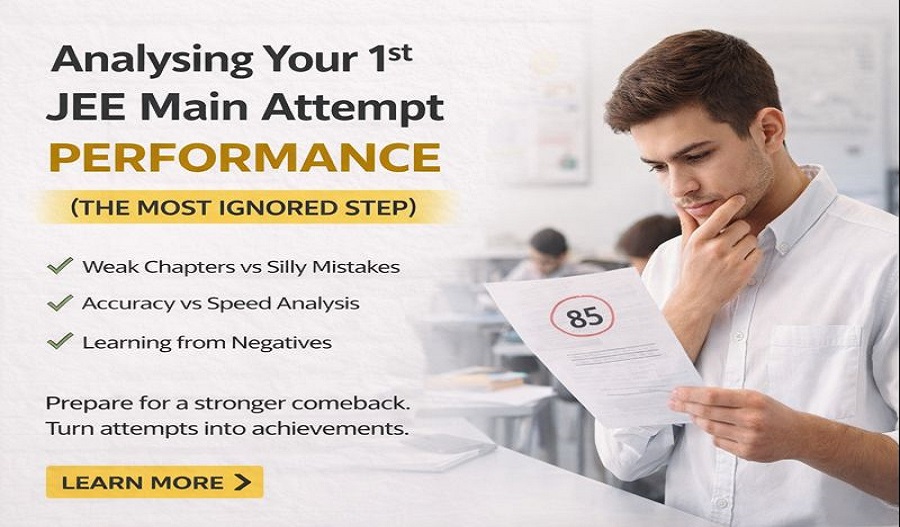
For many JEE aspirants, the first attempt ends with just one thought: "I need to study harder." But toppers think differently. They analyse before they act. Your 1st JEE Main attempt is not a verdict — it is a detailed feedback report. If you learn how to read it correctly, your 2nd attempt preparation becomes sharper, smarter, and more result-oriented.
Why Analysis Matters More Than Extra Study
Studying more without analysis often means repeating the same mistakes. A proper performance analysis helps you
- Identify real weak areas, not assumed ones
- Improve accuracy without increasing study hours
- Decide what to revise, what to practice, and what to avoid
Turn average scores into big percentile jumps
Step 1: Subject-Wise Score Breakdown
Start by separating your performance in Physics, Chemistry, and Mathematics.
Ask yourself:
- Which subject gave the lowest return for effort?
- Did any subject consume too much time with low marks?
- Where was accuracy high but attempts low?
This breakdown shows where improvement will impact your percentile the most.
JEE Practice Tests : Click Here
Step 2: Accuracy vs Attempts — The Real Eye-Opener
Many students focus only on the number of questions attempted. That’s a mistake.
Analyse:
- Correct questions
- Incorrect questions
- Unattempted questions
If incorrect answers are high, your focus should be concept clarity and controlled attempts. If unattempted questions are high, work on speed and confidence.
Step 3: Identify Mistake Patterns
Every wrong answer falls into a category:
- Conceptual error
- Calculation mistake
- Misreading the question
- Guesswork under pressure
Once you identify patterns, you can fix multiple marks with one correction strategy.
Step 4: Chapter-Wise Performance Analysis
Go chapter by chapter and note:
- Chapters where questions were easy but still went wrong
- High-weightage chapters with poor accuracy
- Strong chapters where marks were lost due to silly mistakes
These chapters should become your priority revision list for the 2nd attempt.
Ranker's Package : Click Here
Step 5: Time Management Review
Ask honest questions:
- Did you spend too long on tough questions?
- Did Maths eat up time meant for other subjects?
- Were easy questions skipped due to panic?
Fixing time strategy alone can add 10–20 marks without learning anything new.
Step 6: Compare with Cut-Off & Target Percentile
Instead of comparing with friends, compare with:
- Cut-off percentile
- Your target college percentile
Calculate how many net marks you need to improve and plan accordingly. This keeps preparation focused and realistic.
Step 7: Turn Analysis into an Action Plan
Analysis without action is useless. Convert insights into:
- Chapter-wise revision slots
- Daily error-correction practice
- Weekly mock analysis routine
This is where real improvement begins.
Final Takeaway
Your 1st attempt already told you what not to do again. The students who improve the most are not the ones who study longer — they are the ones who study smarter based on analysis.
Don’t chase motivation. Chase clarity.
Because in competitive exams, improvement comes from fixing mistakes — not repeating effort.
If you’re preparing for the JEE Main 2nd attempt or transitioning to JEE Advanced, make performance analysis your first step — not your last
| JEE Mock Test : Click Here | JEE Question Bank : Click Here |

.png)