Too Early or Too Late? The Perfect Time to Start JEE & NEET
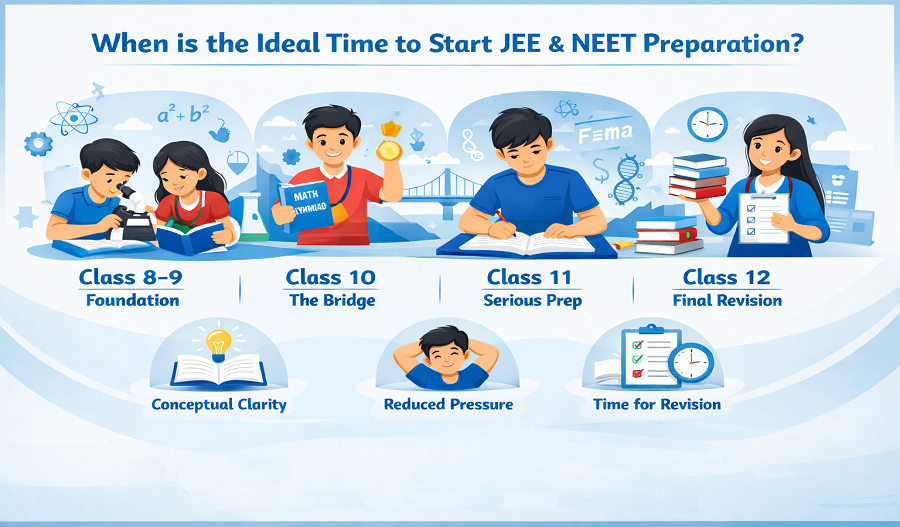
Every year, lakhs of students appear for JEE and NEET - two of India's most competitive entrance exams. Some crack it in their first attempt. Others struggle despite years of effort. What makes the difference?
It is not just hard work. It is hard work combined with a well-defined timeline.
The question "When should I start preparing?" does not have a single perfect answer. But starting early - with the right approach - provides a significant competitive edge. Let us break down exactly what "early" means and how to approach preparation at different stages.
The Grade-Wise Breakdown: Your Preparation Roadmap
The Foundation Stage
Classes 8 and 9 are not about rushing into JEE/NEET syllabus. They are about building a strong conceptual foundation in Mathematics, Physics, Chemistry, and Biology.
Focus Areas:
- Strengthen basic principles and concepts in Math and Science
- Develop analytical thinking and problem-solving skills
- Build discipline and study habits
- Focus on understanding, not memorization
What NOT to do: Do not jump into advanced competitive exam topics. This stage is about depth in basics, not breadth in advanced concepts.
Key Takeaway: Think of this stage as building the roots of a tree. The stronger the roots, the taller the tree can grow. Your competitive exam success in Class 11-12 depends heavily on how well you understand fundamentals now.
The Bridge Year
Class 10 is the perfect bridge between school basics and competitive exam concepts. This is when serious preparation should begin to take shape.
Focus Areas:
- Bridge the gap between school curriculum and competitive concepts
- Start practicing slightly advanced problems
- Participate in Olympiads like IOQM (Indian Olympiad Qualifier in Mathematics) to build problem-solving aptitude
- Begin familiarizing yourself with JEE/NEET question patterns
- Score well in boards while maintaining competitive exam focus
Why Class 10 matters: Students who use this year strategically enter Class 11 with momentum, confidence, and a head start over peers who begin from scratch.
The Critical Year
This is the most important year for JEE and NEET preparation. The core competitive syllabus begins here, and how well you grasp these concepts determines your success.
Why Class 11 is Critical:
- Almost 60-70% of JEE/NEET syllabus comes from Class 11
- Concepts are more complex and require deep understanding
- Poor foundation in Class 11 makes Class 12 extremely difficult
- This is when serious competitive coaching begins for most students
Important: It is NOT Too Late!
Many students worry that starting in Class 11 means they are "behind." This is completely false. Class 11 is the standard starting point for serious preparation. Even top rankers begin their structured preparation here. The key is consistency and a good study plan.
Focus Areas:
- Master every concept thoroughly - do not leave gaps
- Practice daily - both theory and numericals
- Build a strong revision cycle from day one
- Join a good coaching or follow a structured online program
- Balance school exams with competitive preparation
The Execution Year
Class 12 is about full syllabus revision, intensive practice, and exam preparation while also managing board exams.
Focus Areas:
- Complete remaining syllabus by September-October
- Multiple rounds of full syllabus revision
- Take regular mock tests to build exam temperament
- Work on speed and accuracy
- Identify and strengthen weak topics
- Balance board exam preparation with competitive exam focus
Balancing Boards and Competitive Exams: Many students worry about managing both. The truth is, board exam preparation (especially NCERT) directly helps with NEET and provides a solid foundation for JEE. They are not separate - they complement each other.
Benefits of Starting Early
Conceptual Clarity
Time to understand concepts deeply, not just memorize formulas
Reduced Pressure
Gradual learning pace prevents last-minute panic and burnout
Multiple Revisions
Time for 3-4 full revisions, crucial for long-term retention
1. Conceptual Clarity
When you start early, you have the luxury of time to truly understand Physics, Chemistry, Mathematics, and Biology. You can explore different methods, ask questions, make mistakes, and learn from them - all without the pressure of an approaching exam date.
Students who rush through preparation often memorize without understanding. This works for some questions but fails when the exam asks something slightly different or twisted. Deep conceptual clarity, built over time, allows you to tackle any variation of a problem.
2. Reduced Pressure
Starting early means you can study at a sustainable pace. You do not need to pull all-nighters or skip sleep to cover the syllabus. You can maintain a healthy balance between study, rest, and personal life.
This matters enormously for mental health. Competitive exam preparation is a marathon, not a sprint. Students who burn out in Class 11 struggle to maintain momentum when it matters most - in Class 12.
3. Time for Multiple Revisions
Here is a simple truth: you will forget what you learned. That is how memory works. The only way to retain information long-term is through repeated revision.
Students who start early can revise the entire syllabus 3-4 times before the exam. Those who start late often struggle to complete even one full revision. Multiple revisions are the difference between recognizing a formula and instantly knowing how to apply it.
Advice for "Late" Starters (Class 11/12)
If you are reading this in Class 11 or 12 and feeling anxious about not starting earlier, take a deep breath. It is absolutely NOT too late.
✅ Success is Still Possible
Thousands of students start serious preparation in Class 11 and crack JEE/NEET successfully. Some even start in Class 12 and succeed with focused effort. What matters is not when you start, but how committed you are from this moment forward.
Strategy for Late Starters:
- Create a Time-Bound Study Plan: Break down the syllabus into weekly targets. Be realistic but ambitious. Track your progress daily.
- Prioritize High-Weightage Topics: Not all chapters are equal. Some carry more marks. Focus 70% of your time on high-weightage topics.
- Use Expert Guidance: Coaching or a good online program can streamline your preparation. You do not have time to figure everything out yourself.
- Quality Over Quantity: Instead of solving 100 problems poorly, solve 30 problems thoroughly. Understand every solution deeply.
- Mock Tests are Non-Negotiable: Take at least 2-3 full-length mock tests per week in your final months. They build exam temperament and identify weak areas.
Remember: many students who started "late" outperform those who started "early" simply because they were more focused and consistent.
Essential Success Factors (Regardless of When You Start)
Master NCERT Textbooks
NCERT is not optional - it is the foundation. For NEET especially, almost 70% of questions come directly from NCERT or are NCERT-based. For JEE, NCERT builds the conceptual base that advanced problems test. Read every line. Solve every example and exercise.
Regular Mock Tests
Mock tests are not just practice - they are exam preparation training. They teach you time management, question selection strategy, and how to handle pressure. Take them seriously. Analyze every mistake. Mock tests reveal what revision cannot: how you perform under real exam conditions.
Mental Fitness and Discipline
Competitive exam preparation is as much mental as it is academic. Build daily routines. Sleep 7-8 hours. Exercise regularly. Take breaks. Stay connected with family and friends. Mental burnout destroys more dreams than lack of intelligence. Discipline beats motivation every time - study even on days you do not feel like it.
So, When Should You Start?
Here is the honest answer:
- Classes 8-9: Ideal for building a strong foundation that makes later preparation smoother
- Class 10: Great for bridging school concepts to competitive level thinking
- Class 11: Standard and highly effective starting point for serious preparation
- Class 12: Late but still possible with intense focus and smart strategy
The "ideal" time is whenever you decide to commit. Students who start in Class 8 have advantages, yes. But those advantages only matter if they use them well. A focused Class 11 student can outperform a casual Class 9 starter.
What matters most:
- Consistency in daily study
- Deep understanding over surface memorization
- Regular practice and revision
- Learning from mistakes
- Maintaining mental and physical health
Your Journey Starts Now
Whether you are in Class 8 or Class 12, the most important decision you can make is this: start today.
Cracking JEE or NEET is not about being the smartest person in the room. It is about being the most consistent, the most disciplined, and the most determined.
Early starters have time on their side. Late starters have urgency on their side. Both can succeed. The question is not when you start - it is whether you will stay committed to the journey.
With determination and a clear plan, you can achieve success at any stage.

.png)