The Ultimate Guide to CBSE Dress Code 2026
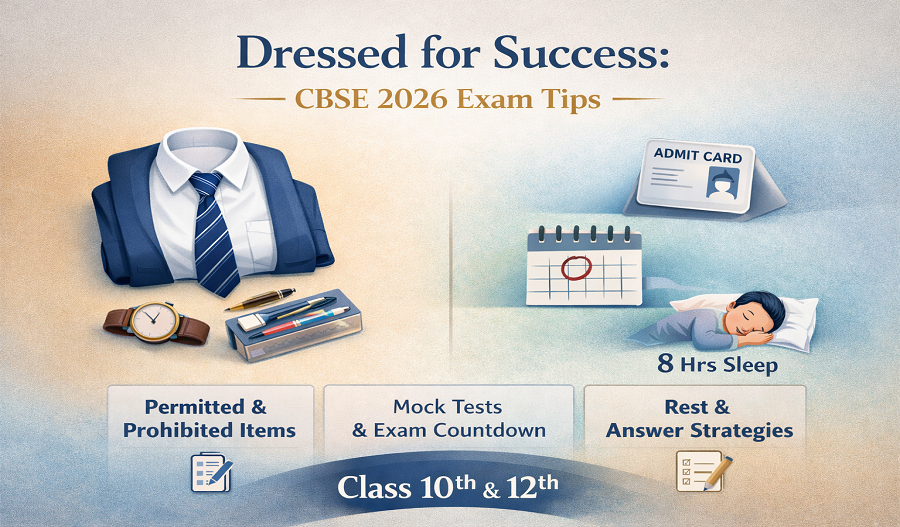
Dressed for Success: CBSE Dress Code 2026 & Critical Exam Day Instructions
Dressed for Success: CBSE Dress Code 2026 & Critical Exam Day Instructions
A comprehensive guide for Class 10th and 12th students covering dress code requirements, permitted and prohibited items, and expert performance strategies for board exam excellence.
CBSE Dress Code Guidelines 2026
The Central Board of Secondary Education (CBSE) has established clear dress code guidelines to maintain uniformity, ensure security, and facilitate smooth exam center operations. Understanding and adhering to these requirements is essential for avoiding unnecessary complications on exam day.
For Regular Students
✓ Mandatory Requirement: All regular students must appear for CBSE Board Class 10 and Class 12 exams in their official school uniform. This requirement is non-negotiable and facilitates identification while promoting discipline and equality among candidates.
For Private Candidates
Private candidates who are not enrolled in regular schools should follow these guidelines:
- Light-colored clothing: Wear simple, light-colored formal attire that is comfortable for extended sitting
- Avoid heavy fabrics: Dark colors and heavy materials are discouraged as they may trigger additional security scrutiny
- Simple design: Clothing should not have large buttons, elaborate embroidery, or excessive decorative elements
- Modest and formal: Maintain professional appearance appropriate for an examination setting
General Dress Code Principles
- No heavy jewelry: Earrings, nose pins, anklets, bracelets, rings, and necklaces should be strictly avoided as they slow down security frisking
- Footwear considerations: Wear light sandals, slippers, or simple shoes without thick soles or metal parts. Avoid heavy boots or heeled footwear
- Avoid zip pockets and large buttons: These can complicate security checks and should be minimized
- Comfort is essential: You will spend 3+ hours in the examination hall; choose clothing that allows you to focus on the exam, not discomfort
⚠️ Important Note: Students who arrive in inappropriate dress may face delays during security frisking or, in extreme cases, may not be permitted entry to the examination center. Plan your outfit the night before to avoid last-minute stress.
Permitted Items: What You Can Bring
CBSE has specified a limited list of items that candidates are permitted to carry into the examination hall. Bringing only these items ensures faster entry and avoids complications.
- CBSE Admit Card 2026: Mandatory for all students
- School ID Card: For regular students
- Government Photo ID: For private candidates (Aadhaar, Passport, Voter ID)
- Transparent pouch: To carry all stationery
- Blue/Royal blue pens: Gel or ballpoint
- Pencils and erasers: For diagrams
- Geometry box: For Mathematics (ruler, compass, protractor)
- Simple analog watch: Only non-digital, non-smart watches allowed
- Transparent water bottle: For hydration during the exam
- Travel essentials: Metro card, bus pass, or cash for transportation (to be submitted at entry)
- Medical items (diabetic students): Water bottles, snacks, glucometer, insulin pumps (with prior notification to superintendent)
✓ Pro Tip: Pack your transparent pouch with stationery the night before and keep it with your admit card. This prevents last-minute scrambling and ensures you don't forget essential items.
Prohibited Items: What You Cannot Bring
CBSE enforces a zero-tolerance policy for prohibited items. Carrying any of these items can result in confiscation, exam center entry denial, or even examination disqualification under the "Unfair Means" category.
⚠️ Critical Warning: Even if electronic devices are switched off, they are still prohibited. Storage facilities may not be available at all centers, so leave these items at home.
Electronic and Communication Devices (Strictly Prohibited)
- Mobile phones (even if switched off)
- Smartwatches and digital watches
- Bluetooth devices, earphones, earbuds
- Fitness bands and health trackers
- Cameras and recording devices
- Microphones and pagers
- Electronic pens, scanners
Study Materials and Calculators
- Textbooks and notebooks (including NCERT books)
- Study notes and guidebooks
- Calculators (except for students with learning disabilities like dyscalculia who have CBSE approval)
- Log tables (these will be provided by exam centers if needed)
- Pen drives and USB devices
Personal Items
- Wallets and purses
- Handbags and backpacks
- Non-transparent pouches
- Goggles and sunglasses
- Food items (except for diabetic students with prior medical documentation)
Unfair Means Items
- Chits or unauthorized notes
- Any written material on body, clothing, or accessible surfaces
- Any gadgets or devices that could facilitate cheating
Also Read : Achieve Higher Retention: Mind Maps Explained
Expert Performance Hacks for Board Exam Success
Beyond dress code compliance, these evidence-based strategies will help you maximize your performance on exam day.
Strategy 1: The 30-Second Reading Rule
One of the most common reasons students lose marks is misreading questions. Words like "NOT," "EXCEPT," "INCORRECT," or "CANNOT" completely change a question's meaning.
- Use the 15-minute reading time wisely to scan the entire paper
- For each question you attempt, take a full 30 seconds to read carefully
- Underline or circle qualifier words (not, except, always, never)
- Restate the question in your own words mentally before answering
- This precision prevents costly "silly mistakes" that account for 10-15% of mark loss
Strategy 2: Building Exam Stamina (Diagnostic Phase)
The CBSE board exam is a 3-hour marathon, not a sprint. Mental stamina is as important as subject knowledge.
- Timing matters: Take full-length mock tests at the exact same time as your actual exam (typically 10:30 AM start)
- Simulate conditions: Sit at a desk, use only permitted materials, set a 3-hour timer with no breaks
- Build gradually: Start with 2-hour practice sessions 2 months before exams, extend to full 3 hours by 3-4 weeks before
- Track concentration: Note when your focus wavers (usually around the 2-hour mark) and practice pushing through
Strategy 3: The Tapering Strategy (Final 24 Hours)
What you do the day before the exam is as critical as months of preparation.
- No new topics: The final 24 hours is for rest and light review only, not learning new material
- 8 hours of sleep: Non-negotiable. A rested brain outperforms a panicked, exhausted one by 20-30%
- Light revision: Review formula sheets, key definitions, or one-page summaries—nothing that requires heavy cognitive load
- Avoid social media: The night before exams, log out of all apps to prevent anxiety from peer discussions
- Pack and verify: Lay out clothes, pack admit card and stationery, and verify everything before sleeping
Strategy 4: Originality in Expression
For subjects like English, Hindi, or humanities, examiners reward your own words over memorized guidebook answers.
- Understand the concept deeply enough to explain it in your unique voice
- Avoid reproducing exact sentences from sample papers or guides
- Use varied vocabulary and sentence structures to demonstrate comprehension
- Personal examples (when appropriate) make answers memorable and authentic
Strategy 5: Step-Wise Precision for Numerical Subjects
In Mathematics, Physics, Chemistry, and Accountancy, showing your work is as important as the final answer.
- Never skip steps: Even if the calculation seems obvious, write it down
- Label each step: Given, To Find, Formula, Substitution, Calculation, Answer with units
- Partial marks insurance: Even if your final answer is wrong due to calculation error, step-wise logic earns 60-70% of question marks
- Box final answers: Make it easy for examiners to locate and mark your conclusion
Strategy 6: Visual Timeline Milestone (Exam Countdown App)
Use the Exam Countdown app to create a visual timeline of your exam dates and preparation milestones.
- Set countdowns for each subject's exam date
- Create milestones: "Syllabus Complete," "Revision Start," "Mock Test Series," "Final Revision"
- Seeing time tick away in real-time prevents procrastination
- Reduces last-minute panic that leads to forgotten admit cards or dress code violations
Strategy 7: Answer Presentation Mastery
How you present your answer is as important as what you write. Toppers master this art.
- Neat headings: Underline question numbers and main headings in your answers
- Bullet points for lists: When listing factors, types, or examples, use bullet points or numbering for clarity
- Underline key terms: Scientific names, formulas, dates, and important keywords should be underlined
- Short paragraphs: Break long answers into 3-4 sentence paragraphs for readability
- Diagrams and labels: In Science subjects, neat diagrams with all parts labeled can earn 2-3 marks alone
- Legible handwriting: If examiners struggle to read your writing, they may mark you down even if content is correct
Frequently Asked Questions
Your Exam Day Checklist
Use this comprehensive checklist the night before and morning of your exam to ensure nothing is forgotten:
✓ Lay out school uniform (or appropriate dress)
✓ Pack transparent pouch with stationery
✓ Keep admit card and ID in accessible place
✓ Charge simple analog watch
✓ Fill transparent water bottle
✓ Get 8 hours of sleep
✓ Eat a nutritious breakfast
✓ Verify you're wearing permitted clothing
✓ Double-check admit card and ID
✓ Leave home to arrive 30-45 min early
✓ Leave phone and prohibited items at home
✓ Stay calm and confident
• Final Wisdom: The students who excel are not necessarily the smartest—they are the most prepared, the most precise, and the most composed under pressure. Master the administrative details, implement the strategic techniques, and trust in your months of preparation. You are ready.
Your board exam journey represents years of learning culminating in these critical moments. Approach each exam with the respect it deserves: proper dress, proper preparation, and proper execution. Excellence is not an accident—it is the result of deliberate choices made consistently over time.
Best wishes for your CBSE Board Exams 2026. You've prepared well—now perform brilliantly.
Also Read : CBSE Class 12 Board Exam Preparation Tips

.png)