The Pinnacle of Preparation: NEET Chapter Weightage Revealed
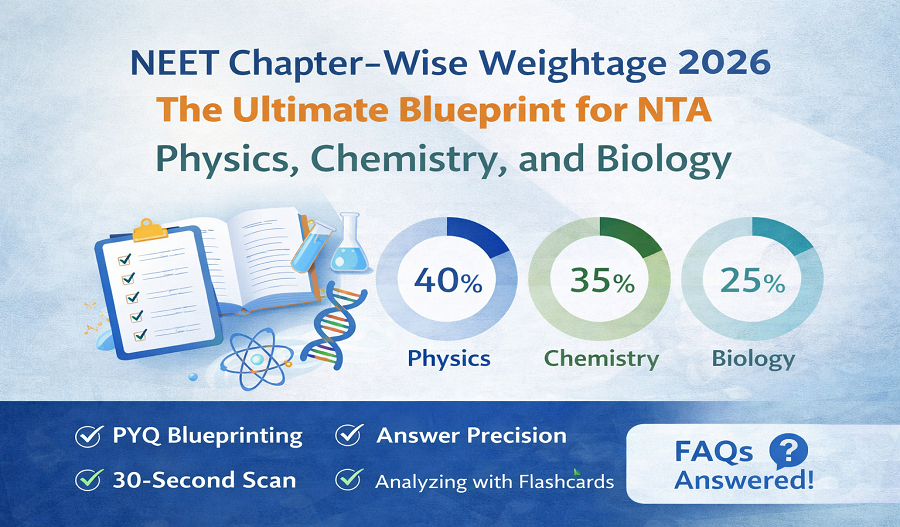
NEET Chapter-Wise Weightage 2026
The Ultimate Blueprint for NTA Physics, Chemistry, and Biology
In NEET 2026, strategic preparation trumps exhaustive coverage. Understanding chapter-wise weightage is not about gaming the system—it's about intelligent resource allocation. With 180 questions distributed across Physics, Chemistry, and Biology, every hour of preparation must be invested where it yields maximum returns under examination pressure.
This comprehensive blueprint deconstructs NTA's chapter-wise weightage patterns, providing you with the tactical framework to transform scattered preparation into precision-targeted mastery. Your success in NEET 2026 depends not on how much you study, but on how strategically you allocate your cognitive resources across high-yield chapters.
Understanding NTA's Weightage Distribution Philosophy
The National Testing Agency's question distribution follows discernible patterns across years. While individual questions change, the underlying chapter weightage remains remarkably consistent. This consistency is your strategic advantage.
Physics: The High-Risk, High-Reward Domain
Physics carries 45 questions (180 marks) with a distinct weightage hierarchy:
High-Weightage Chapters (8-12 questions each):
- Current Electricity: Circuit analysis, Kirchhoff's laws, capacitors
- Optics: Ray optics, wave optics, optical instruments
- Modern Physics: Photoelectric effect, atomic structure, nuclei
- Electrostatics: Electric field, potential, capacitance
- Magnetic Effects of Current: Ampere's law, magnetic field, moving charges
Medium-Weightage Chapters (4-6 questions each):
- Mechanics: Laws of motion, work-energy, rotational dynamics
- Thermodynamics: Laws, heat engines, kinetic theory
- Waves: SHM, sound waves, wave properties
- Electromagnetic Induction: Faraday's law, AC circuits
Lower-Weightage Chapters (1-3 questions each):
- Gravitation, Fluid Mechanics, Properties of Matter
- Communication Systems, Semiconductor Electronics
Chemistry: The Scoring Stabilizer
Chemistry's 45 questions (180 marks) are split between Physical, Organic, and Inorganic chemistry:
Physical Chemistry High-Yield Topics:
- Chemical Kinetics: Rate laws, reaction mechanisms (6-8 questions)
- Electrochemistry: Cells, Nernst equation, conductance (5-7 questions)
- Equilibrium: Le Chatelier's principle, equilibrium constants (4-6 questions)
- Thermodynamics: Laws, enthalpy, spontaneity (4-5 questions)
Organic Chemistry High-Yield Topics:
- Reaction Mechanisms: SN1, SN2, elimination, addition (7-9 questions)
- Aromatic Chemistry: Benzene reactions, directing groups (5-6 questions)
- Biomolecules: Carbohydrates, proteins, nucleic acids (4-5 questions)
- General Organic Chemistry: Isomerism, nomenclature (3-4 questions)
Inorganic Chemistry High-Yield Topics:
- Coordination Compounds: Nomenclature, bonding, isomerism (5-6 questions)
- Chemical Bonding: Hybridization, molecular orbital theory (4-5 questions)
- d and f Block Elements: Properties, reactions (4-5 questions)
- p-Block Elements: Group properties, important compounds (6-7 questions)
Biology: The Volume Champion
Biology dominates NEET with 90 questions (360 marks total—180 for Botany, 180 for Zoology):
Botany High-Weightage Chapters:
- Plant Physiology: Photosynthesis, respiration, transport (12-15 questions)
- Genetics & Evolution: Mendelian genetics, molecular basis (8-10 questions)
- Reproduction in Plants: Sexual and asexual reproduction (6-8 questions)
- Ecology: Ecosystems, biodiversity, environmental issues (7-9 questions)
- Plant Morphology: Structure and function (5-7 questions)
Zoology High-Weightage Chapters:
- Human Physiology: Digestive, respiratory, circulatory, excretory systems (15-18 questions)
- Genetics & Evolution: Molecular basis, evolution theories (8-10 questions)
- Reproduction: Human reproduction, reproductive health (7-9 questions)
- Cell Biology: Cell structure, cell cycle, biomolecules (6-8 questions)
- Ecology & Environment: Population ecology, conservation (6-8 questions)
The Marathon Sprint Mindset
NEET preparation for high-weightage chapters is neither a leisurely marathon nor a panicked sprint—it's a marathon sprint. This mental framework transforms how you approach revision:
You're Not Starting Fresh—You're Sharpening
The mistake most aspirants make: treating high-weightage chapter revision as if learning from scratch. You've already encountered these topics in school, coaching, or self-study. The marathon sprint mentality recognizes that your task is not acquisition but refinement.
What This Means in Practice:
- For Physics: Don't re-derive every formula. Instead, drill application under varied conditions until conceptual patterns become automatic
- For Chemistry: Don't re-memorize every reaction. Focus on mechanisms and pattern recognition that accelerate problem-solving
- For Biology: Don't re-read entire chapters. Target diagrams, processes, and exceptions that distinguish high scorers from average performers
The marathon element: sustained, consistent engagement over months. The sprint element: high-intensity, precision-focused work during each study session. Combined, they create the cognitive sharpness needed for NEET's time-pressured environment.
The 70-20-10 Revision Rule
Most students misallocate revision time by either obsessing over weaknesses or comfortably camping in strong areas. The 70-20-10 framework provides strategic balance:
70% - Perfecting Strong Areas
This seems counterintuitive. Why spend the majority of time on chapters you already know? Because NEET's negative marking and time pressure demand absolute reliability in your strong domains.
Strategic Implementation:
- If you're strong in Organic Chemistry mechanisms, don't just "know" them—aim for 100% accuracy at 40 seconds per question
- If Human Physiology is your fortress, drill until you can draw every system diagram from memory with perfect labeling
- If Electrostatics clicks naturally, practice until you can solve complex multi-concept problems without hesitation
Why This Matters: In the exam hall under stress, your "strong" areas are what prevent catastrophic score collapse. These are your guaranteed marks—make them absolutely bulletproof.
20% - Preventing Score Leakage in Weak Areas
You cannot master everything, nor should you try. The goal with weak areas is not expertise—it's damage control.
Tactical Approach:
- Identify 2-3 persistently problematic high-weightage chapters
- Focus on frequently asked subtopics within those chapters, not comprehensive mastery
- Use PYQ analysis to determine which specific question types appear most often
- Build "recognition patterns" even if deep understanding remains elusive
For example: If Modern Physics consistently troubles you, don't try to master quantum mechanics. Instead, memorize the 5-6 formula patterns that cover 80% of NEET questions in that chapter.
10% - New Topic Exploration (Only If Necessary)
This is the smallest allocation for good reason: learning genuinely new content in the final preparation months is cognitively expensive and strategically risky.
Use This 10% Only When:
- A high-weightage chapter has been completely neglected
- Your mock test analysis reveals a critical gap that's costing significant marks
- You have excess capacity after mastering the 70% and addressing the 20%
Critical Warning: Most students should spend their 10% not on new topics but on advanced problem-solving in existing strong areas. Expanding breadth at the cost of depth is the classic NEET preparation error.
The Library Catalogue Memory System
Your brain is a vast library containing thousands of facts, formulas, mechanisms, and diagrams. The difference between high performers and average scorers isn't library size—it's catalogue quality.
The Filing System Problem
Consider this exam hall scenario: A question asks about the mechanism of photosynthesis in C4 plants. Your brain knows this information—you studied it weeks ago. But under the 3-hour time pressure, your mental search returns:
- A vague memory of C4 vs C3 differences
- Confusion with CAM pathway mechanisms
- Partial recall of the Calvin cycle
- Uncertainty about which enzyme is involved
This is a filing system failure. The knowledge exists but lacks proper organization for rapid, pressure-proof retrieval.
The Leitner System Solution
The Leitner System is a scientifically-grounded flashcard method that automates optimal review scheduling. It's particularly powerful for high-weightage NEET chapters with dense factual content.
Implementation for NEET:
- Create flashcards for high-yield facts:
- Biology: Definitions, exceptions, diagrams, process steps
- Chemistry: Reaction mechanisms, exceptions to rules, important compounds
- Physics: Formula applications, conceptual distinctions, numerical patterns
- Establish three review boxes:
- Box 1 (Daily): New cards and those you got wrong
- Box 2 (Every 3 days): Cards you've answered correctly once
- Box 3 (Weekly): Cards you've mastered with multiple correct answers
- Promotion/Demotion rules:
- Correct answer: Card moves to next box
- Incorrect answer: Card returns to Box 1, regardless of previous level
Why This Works: The system forces you to spend time where you need it most (Box 1) while maintaining long-term retention of mastered material (Box 3) through strategically timed review. It's self-optimizing memory architecture.
PYQ Blueprinting: The Strategic Intelligence Operation
Previous Year Questions are not just practice material—they are intelligence data revealing NTA's testing patterns, preferred phrasings, and conceptual priorities.
The 10-Year Analysis Protocol
For each high-weightage chapter, conduct systematic PYQ analysis covering the last decade:
Step 1: Frequency Mapping
Create a spreadsheet tracking how many questions each subtopic generated across 10 years. For example, in Genetics, you might find: Mendelian genetics (18 questions), Molecular basis of inheritance (22 questions), Linkage and crossing over (12 questions).
Step 2: Phrasing Pattern Recognition
Note the specific language NTA uses. Chemistry questions often ask "Which of the following statements is incorrect?" Physics questions frequently involve multi-step reasoning. Biology questions test exception knowledge with "All of the following are true EXCEPT."
Step 3: Difficulty Progression Analysis
Track whether questions in specific chapters are becoming more application-based or remaining theory-focused. This reveals preparation priorities.
Step 4: Trap Identification
Document recurring traps: similar-looking formulas (Physics), confusing isomers (Organic Chemistry), taxonomic exceptions (Biology). Create a "common traps" flashcard deck.
Strategic PYQ Solving Schedule
Don't save all PYQs for the final month. Integrate them throughout preparation:
- Months 1-3: Solve chapter-wise PYQs immediately after completing each chapter's theory
- Months 4-6: Re-solve all PYQs from high-weightage chapters to identify retention gaps
- Months 7-9: Solve full-year papers (2014-2024) under timed conditions
- Final Month: Review only the questions you got wrong across all previous attempts
The 30-Second Precision Scan
NEET's negative marking makes careless reading catastrophically expensive. A misread "not" or overlooked "except" can cost you 5 marks (4 marks lost + 1 penalty). The 30-second precision scan is insurance against this silent score killer.
The Protocol
Before attempting any solution—especially in high-weightage Physics chapters—invest 30 full seconds in systematic reading:
High-Risk Keywords to Flag:
- "NOT" - Completely reverses the question's requirement
- "EXCEPT" - You need the outlier, not the pattern
- "INCORRECT" - Seeking the false statement among true ones
- "ONLY" - Eliminates partial truths; answer must be exclusively correct
- "ALWAYS" / "NEVER" - Absolute qualifiers that change logical scope
- "MOST" / "LEAST" - Comparative terms requiring ranking
Physically (mentally or with your pencil) underline these trap words. This kinesthetic engagement forces conscious awareness rather than autopilot reading.
Subject-Specific Applications
Physics:
Physics questions often hide complexity in seemingly simple phrasing. "A particle moves with constant velocity" is fundamentally different from "constant speed." The 30-second scan catches these distinctions.
Chemistry:
Organic Chemistry questions frequently test exceptions: "Which of the following does NOT undergo..." The scan ensures you're solving for the exception, not the rule.
Biology:
Biology's fact-dense questions often include "All of the following are correct EXCEPT." Without careful scanning, you might solve for correctness instead of the exception.
Answer Architecture & Logic
While NEET is entirely MCQ-based, the way you practice—even for multiple choice—profoundly impacts exam performance. Answer architecture training builds the mental stamina and logical clarity needed for complex problem-solving under pressure.
For Biology: Flowcharts and Diagrams
Even though you won't draw diagrams in the actual exam, practicing with them transforms how you think about processes:
- Draw from memory: Cardiac cycle, nephron function, photosynthesis pathways
- Label completely: Every structure, every enzyme, every intermediate
- Create flowcharts: DNA replication steps, protein synthesis, hormone pathways
Why This Matters: When the exam presents a question about a specific step in photosynthesis, your brain doesn't just recall isolated facts—it accesses the complete visual map, making errors obvious and correct answers clear.
For Chemistry: Mechanism Mapping
Write out complete reaction mechanisms during practice, even for simple reactions:
- Show electron movement with curved arrows
- Identify intermediates and transition states
- Note leaving groups and attacking species
- Explain why specific products form
This practice trains pattern recognition. In the exam, you instantly recognize reaction types and predict products without working through full mechanisms.
For Physics: Step-Wise Logic
Never jump to answers. Practice writing:
- Given: List all provided values and conditions
- Required: State exactly what you're solving for
- Principle: Name the law/concept you'll apply
- Solution: Show each calculation step
- Verification: Check units, reasonableness of magnitude
This structured thinking prevents the common error of grabbing formulas randomly until something "looks right." It builds the disciplined logic that catches mistakes before they cost marks.
The 2026 Tech-Stack
Strategic technology use amplifies preparation efficiency. These tools serve specific, non-overlapping purposes in your NEET preparation architecture:
Anki: The Flashcard Revolution
Purpose: Implementing the Leitner System for biology definitions, chemistry reactions, and physics formulas.
Optimal Use Cases:
- Biology taxonomic classifications and exceptions
- Chemistry named reactions and reagent combinations
- Physics dimensional formulas and unit conversions
- Mnemonics for remembering complex sequences
Pro Tip: Create image-occlusion cards for diagrams. Anki can hide parts of anatomical diagrams or reaction mechanisms, forcing active recall of specific components.
Quizlet: Gamification for Engagement
Purpose: Transforming monotonous memorization into engaging challenges.
Strategic Modes:
- Match Mode: Speed-based pairing of terms and definitions, ideal for competitive self-challenge
- Gravity Mode: Type answers before definitions fall, building rapid recall under time pressure
- Test Mode: Mixed question types (multiple choice, true/false, written) for comprehensive review
Best For: Breaking monotony during long study sessions. Use as 10-minute energizing breaks between intensive problem-solving blocks.
Final Readiness Checklist for NEET 2026 Exam Hall
Pre-Exam Week (Final 7 Days)
Final 48 Hours
Exam Morning
In the Examination Hall
Frequently Asked Questions
Your NEET 2026 score will be determined not by how much you know, but by how strategically you weaponize chapter-wise weightage intelligence.
Master high-yield chapters with precision. Execute with clarity. Trust your systematic preparation.

.png)