The Best Strategies for April Comeback in JEE Main
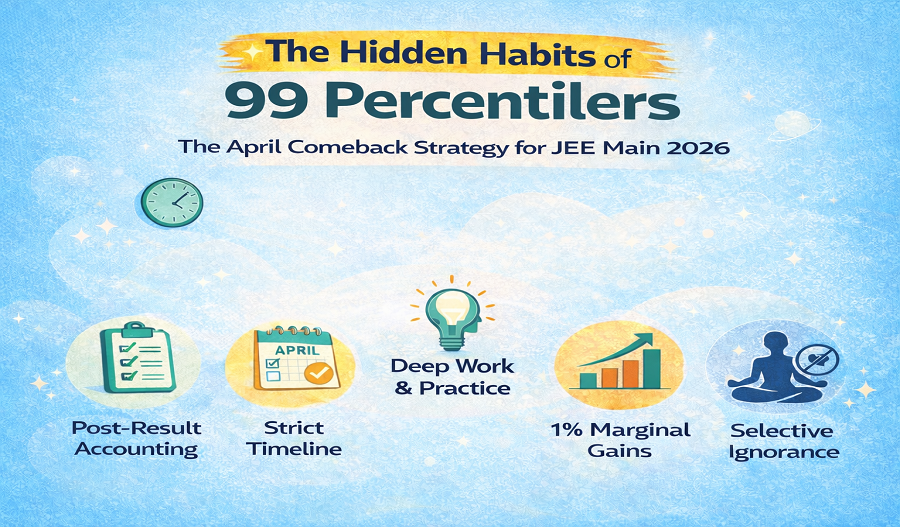
The Hidden Habits of 99 Percentilers
The April Comeback Strategy for JEE Main 2026
The JEE Main first attempt results are out. Some of you are celebrating. Others are disappointed. But here's what matters: April is your second chance, and it's the one that counts.
This is not a motivational speech. This is a strategic roadmap based on what 99 percentilers actually do differently. They don't rely on luck or sudden brilliance. They follow specific habits and systems that you can apply starting today.
1. The Post-Result Accounting
Before you plan what to do next, you need to understand exactly what went wrong in the first attempt. Not emotionally—strategically.
High performers do something called "daily accounting." They measure what matters. You need to do a one-time, thorough accounting of your first attempt.
Your First Attempt Analysis Checklist:
Write down clear, specific answers. "I was weak in Math" is not useful. "I lost 20 marks in Coordinate Geometry due to calculation errors and 12 marks in Calculus because I didn't know integration techniques" is useful.
The Stoic Approach: Focus Only on What You Control
You cannot control your first attempt score anymore. It's done. What you can control:
- How many hours you study each day
- Which topics you revise
- How many mocks you take
- Your sleep schedule and health
- Your exam day strategy
Everything else—your past score, what your friends scored, what percentile you "should have" gotten—is mental noise. Let it go.
2. Protecting the April Timeline
You have limited time. Every day between now and April matters. You need a plan that is both ambitious and realistic.
Many students make the mistake of creating superhuman schedules after a disappointing result. "I'll study 15 hours a day from tomorrow!" This lasts three days, then they burn out.
Don't Make These Planning Mistakes:
- Planning to study 12-15 hours daily (unsustainable)
- No buffer time for breaks or unexpected events
- Trying to cover 100% of the syllabus again
- Not scheduling mock tests properly
The Sustainable April Schedule:
- Study time: 8-9 focused hours daily (quality over quantity)
- Mock tests: 3 per week minimum
- Analysis time: 3 hours after each mock
- Revision: Daily quick revision of previous day's topics
- Sleep: Non-negotiable 7 hours
- Buffer: Keep Sundays lighter for recovery
Here's the critical part: Discipline over motivation.
Right now, after seeing your results, you might feel highly motivated. That motivation will fade in a week. What will keep you going is discipline—showing up to study even when you don't feel like it.
Make your schedule simple, write it down, and follow it like a non-negotiable commitment. No "I'll study extra tomorrow." Do today's work today.
3. Deep Work and Deliberate Practice
Not all study hours are equal. There's a difference between shallow work and deep work.
| Shallow Work | Deep Work |
|---|---|
| Re-reading notes you already understand | Solving new, difficult problems that challenge you |
| Solving easy MCQs you can already do | Tackling problems that expose your weaknesses |
| Watching videos passively | Working through derivations and proofs actively |
| Feels comfortable and easy | Feels difficult and requires full concentration |
| Low cognitive load | High cognitive load |
For the April attempt, you need deep work. You already know the basics. What you need now is to sharpen your problem-solving ability.
Deliberate Practice Framework:
- Identify specific weakness: Based on your first attempt analysis
- Practice that exact thing: Solve 20 problems of that type
- Get immediate feedback: Check solutions right after solving, not later
- Understand mistakes deeply: Don't just see the correct answer, understand why your approach was wrong
- Repeat until mastery: Keep practicing until you can solve similar problems consistently
The "Eat the Frog" Strategy
Your willpower is highest in the morning. Use that time for your weakest subject—the one you struggled with most in the first attempt.
If Physics destroyed you in the first attempt, do Physics first thing every morning when your brain is fresh. Don't save the hard stuff for evening when you're tired.
4. The 1% Factor: Marginal Gains
Here's a powerful concept: You don't need to improve your entire performance by 50%. You just need to improve multiple small things by 1% each.
This is called the "Marginal Gains Theory." If you improve every component of your preparation by just 1%, the combined effect is massive.
Areas for 1% Improvements:
- Sleep quality: Go to bed 15 minutes earlier
- Question selection: Learn to identify which questions to skip faster
- Calculation speed: Practice mental math for 10 minutes daily
- Formula recall: Revise formula sheets every morning
- Hydration: Drink enough water (dehydration reduces focus)
- Mock test analysis: Spend an extra 30 minutes on each analysis
- Exam strategy: Refine which section you attempt first
- Break efficiency: Use breaks to actually rest, not scroll social media
None of these individually seems like a big deal. But together, they compound into significant improvement.
Execution Over Perfection
Don't wait to feel "fully prepared" before taking mocks. You learn more from taking a mock, making mistakes, and fixing them than from endless preparation.
Take mocks frequently. Fail fast. Learn quickly. Improve continuously.
5. Achieving Flow State in Mock Exams
"Flow" is a state of peak performance where you're completely absorbed in what you're doing. Time seems to fly. You're working at your best without conscious effort.
99 percentilers often describe their best performances as being "in the zone" or "in flow." This isn't luck. It's a state you can train yourself to enter.
How to Enter Flow During Exams:
- Clear goals: Know exactly what you're trying to achieve (solve this section first, get 30 questions right)
- Immediate feedback: You know instantly if you got a question right or need to think more
- Challenge-skill balance: The exam should be challenging but not impossibly hard
- Full concentration: Eliminate all distractions, focus only on the present question
- Ignore the clock initially: Don't keep checking time every 5 minutes, trust your preparation
You can't force flow, but you can create conditions for it. The more mocks you take with full focus, the better you get at entering this state.
Practice Flow in Mock Tests
During practice mocks, don't just focus on scores. Notice when you feel completely absorbed in solving. That's flow. Try to recreate those conditions in every mock.
6. Ruthless Selective Ignorance
Between now and April, a thousand things will compete for your attention. News. Social media. Friends' results. Coaching institute predictions. College discussions.
Ignore all of it.
This is called "selective ignorance"—deliberately choosing what to ignore so you can focus on what matters.
Energy Drains to Eliminate:
- Social media scrolling (even "study motivation" videos)
- News and current affairs (you're not preparing for UPSC right now)
- Debates about exam difficulty or paper patterns
- Comparing yourself to peers constantly
- Overthinking about college admissions
- Watching long YouTube explanations when you should be solving
Every minute spent on these is a minute not spent improving your weak areas. And you have very few minutes left.
Small, Consistent Actions Win
There is no magic trick that will suddenly make you a 99 percentiler. What works is simple:
- Study focused hours every single day
- Take mocks regularly and analyze them properly
- Fix your weak areas systematically
- Maintain your health and sleep
- Stay consistent until April
That's it. No shortcuts. No secret techniques. Just relentless, consistent effort in the right direction.
Your April Action Plan
Week-by-Week Focus:
Weeks 1-2: Deep Analysis + Foundation Fixing
- Complete thorough first attempt analysis
- Identify top 10 weak areas
- Start targeted practice on weakest 3 topics
- Take 2 mocks this week
Weeks 3-4: Intensive Weak Area Practice
- Dedicate each day to one weak chapter
- Solve 50+ problems per weak topic
- Take 3 mocks per week
- Notice improvement in weak areas
Weeks 5-6: Mock Marathon + Speed Building
- Take 4 mocks per week
- Focus on speed without losing accuracy
- Perfect your section attempt strategy
- Reduce silly mistakes through careful practice
Final Week: Confidence + Fine-tuning
- Light revision of important formulas
- 2-3 mocks maximum
- Focus on mental preparation
- Trust your preparation and stay calm
The Path Forward
Your first attempt score does not define you. What defines you is what you do with the time between now and April.
99 percentilers are not superhumans. They simply understand that success comes from clear thinking, consistent action, and ruthless focus on what matters.
You know what went wrong in the first attempt. You know what you need to fix. You have the time to fix it.
The question is not whether you can improve. The question is: Will you execute the plan with discipline, ignore the noise, and show up every single day until April?
If the answer is yes, then your April comeback is not just possible—it's probable. Start today.

.png)