Personalized Mentorship : The Hidden Factor Behind Exam Success
Every year, millions of students sit for competitive exams like JEE, NEET, and UPSC. They attend the same coaching classes, use the same textbooks, and put in similar hours of study. Yet, some students crack these exams with flying colors while others struggle despite equal effort.
What separates the two groups?
The answer is not intelligence, luck, or some secret study technique. It is something far more powerful: personalised mentorship.
The Science Behind One-to-One Learning
In 1984, educational psychologist Benjamin Bloom conducted groundbreaking research that changed how we understand learning. His findings, known as Bloom's 2 Sigma Problem, revealed something remarkable:
Students with one-to-one tutoring perform better than 98% of students in traditional classrooms
This means that the average student with a personal tutor performs two standard deviations better than their classroom-educated peers. In simple terms, personalised instruction is not just slightly better - it is transformatively better.
Think about that for a moment. The same student, with the same baseline intelligence, studying the same material - can jump from average performance to the top 2% simply by changing how they learn.
The Philosophy of Mastery Learning
At the heart of effective mentorship lies a powerful concept: Mastery Learning.
In traditional classrooms, learning happens on a fixed timeline. The teacher covers Chemical Bonding in two weeks, then moves to the next topic - regardless of whether every student has understood it. Students who fall behind stay behind.
Mastery Learning flips this approach. Instead of fixed time and variable learning, it uses variable time and fixed mastery. A student does not move forward until they have truly mastered the current concept.
The Critical Mindset Shift
In the Mastery Learning model, if a student fails to understand a concept, it is not seen as a failure of the student's ability. Instead, it is viewed as a failure of instruction.
This fundamental shift removes the stigma of "I am not good at math" and replaces it with "I have not been taught this in the right way yet."
This is where personalised mentorship becomes game-changing. A mentor can slow down, speed up, or completely change their teaching approach based on one student's needs - something impossible in a batch of 100 students.
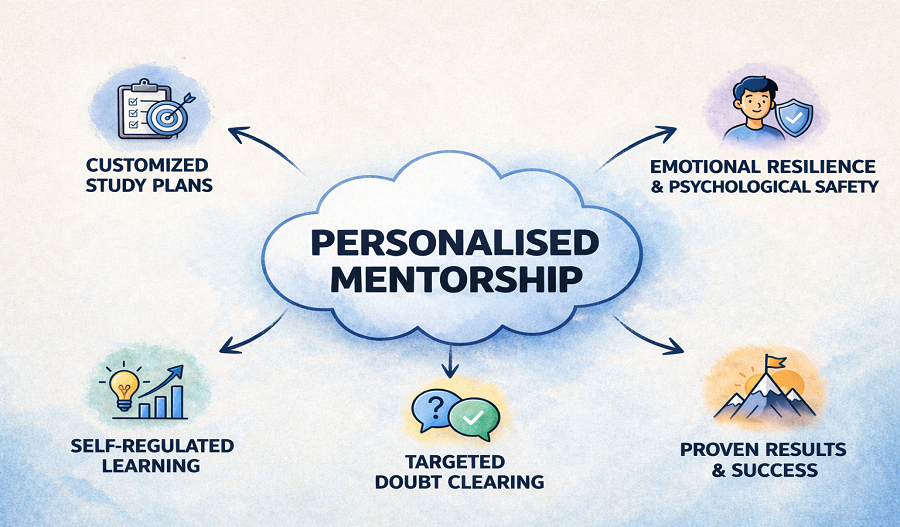
The Four Pillars of Mentorship-Driven Success
Customized Study Plans
No two students are identical. Ravi might be strong in Physics but weak in Organic Chemistry. Priya might excel in theory but struggle with numerical problem-solving. A standard batch teaching plan cannot account for these differences.
A personal mentor creates a baseline assessment of where you currently stand, identifies specific weak areas, and designs a study plan that addresses your gaps - not generic gaps.
Real Example: A NEET aspirant scoring 120/180 in Chemistry found that her weakness was not the entire subject - it was specifically Organic Chemistry reactions and mechanisms. Her mentor restructured her study plan to allocate 40% of Chemistry time to Organic Chemistry instead of the standard 33%. Within three months, her Chemistry score jumped to 155/180.
Customization also accounts for your school workload, sleep patterns, energy levels, and even personal commitments. The plan adapts to you, not the other way around.
Self-Regulated Learning (SRL)
One of the biggest challenges in competitive exam preparation is not lack of resources - it is lack of self-regulation. Students know what to study but struggle with motivation, procrastination, and maintaining consistency.
A mentor helps you develop Self-Regulated Learning skills through:
- Goal-Setting: Breaking down "crack JEE" into weekly, achievable milestones
- Progress Tracking: Regular check-ins that hold you accountable
- Personalized Feedback: Understanding not just what you got wrong, but why you got it wrong
- Motivation Management: Identifying when you are burning out and adjusting pace accordingly
Studies show that students with personalized feedback show significantly reduced procrastination and improved time management compared to those relying on generic study schedules.
Targeted Doubt Clearing
In a large coaching batch, doubt-clearing sessions are chaotic. You raise your hand, ask a question, and get a generic answer that helps the majority but might not address your specific confusion.
With a personal mentor, doubt clearing becomes surgical.
Instead of "I did not understand Thermodynamics," your mentor can ask: "Which part of the First Law are you stuck on? Is it the concept of internal energy or its application in different processes?" They can then walk through your specific thinking process, identify exactly where your understanding breaks down, and fix it line-by-line.
Speed Matters
In batch coaching, you might wait 3 days for a doubt session. With a mentor, you get rapid response - often within hours. This prevents small confusions from compounding into major knowledge gaps.
This targeted approach saves enormous amounts of time. Instead of re-watching 2-hour lectures hoping to catch what you missed, you spend 10 minutes getting precise clarification.
Emotional Resilience and Psychological Safety
Competitive exam preparation is mentally exhausting. The fear of failure, comparison with peers, parental pressure, and self-doubt create enormous psychological stress.
A mentor's role goes beyond academics - they become a source of emotional support and resilience building.
Psychological Safety: Many students hesitate to ask "basic" questions in large batches, fearing judgment. With a mentor, you have a safe space to ask anything - even questions you think are "stupid." This psychological safety is crucial for genuine learning.
Stress Management: A good mentor recognizes signs of burnout and anxiety. They help you manage exam stress through realistic goal-setting, confidence-building conversations, and sometimes, simply listening.
Confidence Building: When you struggle with a topic for weeks and finally crack it with your mentor's help, that victory builds deep confidence. You learn that difficulty is not a sign of inadequacy - it is a normal part of learning.
Real Transformations: From Struggle to Success
From 44th Percentile to 95th Percentile: A JEE aspirant was consistently scoring in the 40-45 percentile range despite attending a top coaching institute. After six months of structured one-to-one mentorship focusing on weak topics (Rotational Mechanics, Electrochemistry, and Integral Calculus), implementing a customized revision cycle, and developing better exam temperament, he jumped to the 95th percentile in JEE Main.
Cracking NEET After Two Attempts: A student who had failed NEET twice was on the verge of giving up. Through personalised mentorship, her mentor identified that her problem was not knowledge - it was exam anxiety and time management. By working on mock test strategies, building psychological resilience, and creating a targeted revision plan for high-weightage topics, she scored 640+ in her third attempt and secured admission to a government medical college.
These are not exceptions. When students receive the right guidance tailored to their needs, dramatic improvements become the norm, not the outlier.
What Makes a Great Mentor?
Not all mentorship is created equal. The quality of a mentor determines the quality of outcomes. Here is what separates exceptional mentors from average ones:
Active Listening
Great mentors spend 80% of the time listening and 20% talking. They understand your thought process before jumping to solutions.
Candid Feedback
They tell you the truth - even when it is uncomfortable. If your study plan is unrealistic, they say so. If you are avoiding difficult topics, they call it out.
Guiding, Not Solving
Instead of giving you the answer, they ask questions that guide you to discover the answer yourself. This builds independent problem-solving skills.
Adaptive Teaching
They change their explanation style, examples, and pace based on how you learn best - visual, verbal, or kinesthetic.
A mentor who embodies these qualities does not just help you prepare for an exam - they help you become a better learner for life.
The Choice is Yours
Competitive exams are designed to be difficult. They test not just knowledge, but discipline, resilience, and strategic thinking. For most students, navigating this alone - or even in a large batch - leaves too much to chance.
Personalised mentorship removes that uncertainty. It gives you a proven framework, expert guidance tailored to your needs, and the psychological support to stay consistent even when motivation wanes.
The data is clear: students with personalised mentorship dramatically outperform their peers. The philosophy is sound: mastery-based learning ensures deep understanding, not surface memorization. The results speak for themselves: thousands of students have transformed their trajectories through the right guidance.
The question is not whether mentorship works. The question is: Are you ready to invest in your success?

.png)