Maximize Your Performance: Speed and Accuracy Mastery
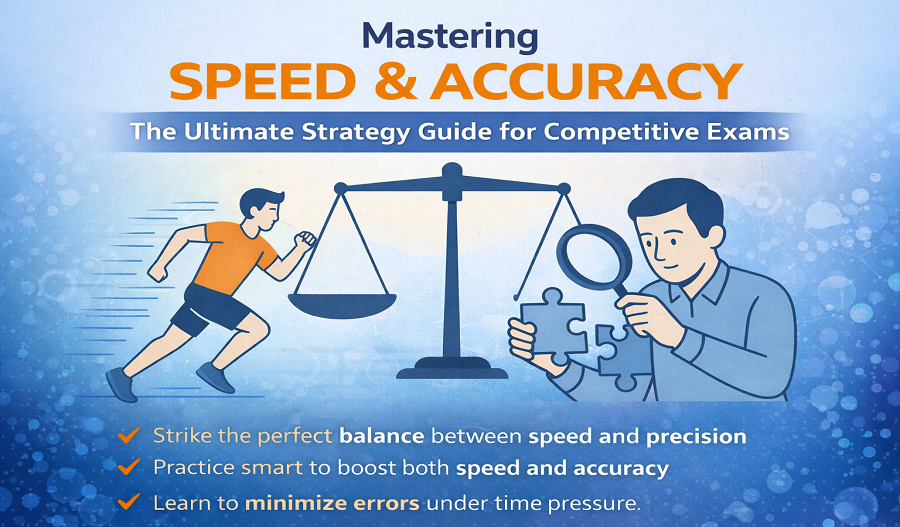
Mastering Speed & Accuracy
The Ultimate Strategy Guide for Competitive Exams
Why Speed & Accuracy Are the Twin Pillars of Exam Success
Imagine this: You know every concept, you've practiced thousands of problems, you're fully prepared—but during the exam, you can only attempt 60% of the questions because you ran out of time. Or worse: you attempt all questions but make careless mistakes on 30% of them due to rushing.
This is the cruel reality of competitive exams like JEE, NEET, CAT, UPSC, and banking exams. Knowledge alone isn't enough. You need speed (solving fast) AND accuracy (solving correctly) working together in perfect harmony.
Think of it like driving a car: Speed without accuracy is reckless (you'll crash). Accuracy without speed is too slow (you won't reach your destination on time). Success lies in finding the "steady and correct" equilibrium.
What is Speed?
Speed is your ability to solve problems quickly without getting stuck. It's about:
- Pattern recognition (instantly identifying problem types)
- Quick recall (formulas, concepts at fingertips)
- Efficient problem-solving (knowing shortcuts and techniques)
- Time management (knowing when to skip and move on)
What is Accuracy?
Accuracy is your ability to solve problems correctly without making errors. It's about:
- Conceptual clarity (deep understanding, not superficial)
- Careful calculation (avoiding silly mistakes)
- Attention to detail (reading questions properly)
- Verification (double-checking critical steps)
The Golden Rule of Speed & Accuracy:
Speed is built through practice. Accuracy is built through understanding.
First, master accuracy through deep conceptual learning. Then, layer speed on top through timed practice. Never sacrifice accuracy for speed—but never neglect speed either. They must grow together!
Section 1: The 80/20 Preparation Strategy
The Pareto Principle (80/20 Rule) is a game-changer for exam preparation. It states that 80% of your exam score comes from 20% of the syllabus. This isn't laziness—it's strategic intelligence!
What Does the 80/20 Rule Mean for Your Exam?
In every competitive exam, certain topics are heavily weighted. For example:
- JEE Physics: Mechanics (25-30%), Electrodynamics (20-25%), Modern Physics (15%) = 60-70% of paper
- NEET Biology: Human Physiology (15%), Genetics (10%), Plant Physiology (10%), Ecology (8%) = 43% of paper
- CAT: Reading Comprehension (40%), Arithmetic (30%), Algebra (15%) = 85% of Quant+VARC
The Strategy: Identify the high-weightage 20% topics in your exam and master them to 90%+ proficiency BEFORE touching low-weightage topics!
How to Apply the 80/20 Rule:
- Analyze Past Papers: Go through last 5-10 years of exam papers. Track which topics appear most frequently and carry maximum marks.
- Create Your Priority List: List all topics in order of weightage (highest to lowest).
- Master the Top 20%: Spend 60-70% of your total study time on these high-yield topics. Solve hundreds of problems until you achieve 90%+ accuracy.
- Cover the Remaining 80%: Once you've mastered high-priority topics, move to medium and low-priority areas. Even basic familiarity here adds marks!
- Time Allocation Example: If you have 6 months (180 days):
- 120 days on top 20% topics (deep mastery)
- 40 days on remaining 80% topics (basic coverage)
- 20 days for revision and mock tests
Pro Tip: The Compounding Effect
High-weightage topics aren't just frequent—they're often foundational. Mastering them improves your understanding of related topics too! For example, mastering Mechanics in Physics helps with Rotational Motion, Work-Energy, and even some Electrostatics problems. It's a strategic multiplier!
Section 2: Scientifically Proven Study Habits
Most students study inefficiently. They passively read textbooks, highlight notes, and hope information "sticks." Neuroscience research shows this is the WORST way to learn. Let's use science-backed techniques instead!
Technique 1: Active Recall (The Memory Superpower)
What is Active Recall?
Active Recall is the practice of retrieving information from memory without looking at notes or books. Instead of re-reading chapters, you actively test yourself on what you remember.
Why it works: Every time you force your brain to recall something, you strengthen the neural pathway to that memory. It's like exercising a muscle—the more you recall, the stronger the memory becomes. Research shows Active Recall improves retention by 50-100% compared to passive reading!
How to Practice Active Recall:
- Close-Book Testing: After studying a chapter, close your book and write down everything you remember
- Flashcards: Create question-answer flashcards. Test yourself daily
- Self-Quizzing: After each study session, solve practice problems without referring to notes
- Teach Someone: Explain concepts to a friend/family member from memory
- Blank Paper Method: Write formulas, concepts, diagrams from memory on blank paper
Common Mistakes to Avoid:
- Don't re-read passively: Re-reading creates familiarity, not memory. Always test yourself!
- Don't peek too early: Struggle for at least 30 seconds before checking answers. The struggle strengthens memory!
- Don't only test what you know: Deliberately practice difficult topics more
- Don't skip wrong answers: Review and understand why you got it wrong
Technique 2: Spaced Repetition (The Forgetting Curve Destroyer)
What is Spaced Repetition?
Spaced Repetition is the practice of reviewing information at increasing intervals over time. Instead of cramming everything at once, you spread out review sessions strategically.
The Science: Hermann Ebbinghaus discovered the "Forgetting Curve"—without review, we forget 70% of learned information within 48 hours! But if you review at optimal intervals (Day 1, Day 3, Day 7, Day 15, Day 30), you can retain information for life. This moves knowledge from short-term to long-term memory!
Day 1 (Learn) → Day 2 (Review) → Day 4 (Review) → Day 8 (Review) → Day 16 (Review) → Day 30 (Review)
Practical Implementation:
- Digital Tools: Use Anki app (free) which automatically schedules reviews based on spaced repetition algorithm
- Manual Method: Keep a revision calendar. Mark review dates for each topic you study
- Daily Routine: Spend first 30 minutes of study time reviewing old topics (spaced repetition) before learning new ones
- Weekend Revision: Dedicate weekends to reviewing the entire week's topics
Technique 3: The Pomodoro Technique (Focus & Energy Management)
What is the Pomodoro Technique?
The Pomodoro Technique is a time management method where you study in focused 25-minute intervals (called "Pomodoros") followed by 5-minute breaks. After 4 Pomodoros, take a longer 15-30 minute break.
Why it works: Your brain's attention span is limited. After 25-50 minutes of intense focus, your cognitive performance drops. Short breaks refresh your brain, restore focus, and prevent mental fatigue. Research shows this maintains high productivity for 6-8 hours straight!
Pomodoro 1 (25 mins): Deep Focus Study
Study one specific topic with ZERO distractions. Phone off, notifications off, door closed.
Break 1 (5 mins): Physical Movement
Stand up, stretch, walk around, hydrate. Do NOT check phone or social media!
Pomodoro 2 (25 mins): Continue or Switch Topic
If topic from Pomodoro 1 is incomplete, continue. Otherwise, switch to next topic.
Break 2 (5 mins): Relax Mind
Close eyes, deep breathing, or light snack. Stay away from screens!
Pomodoro 3 & 4 (25 mins each): Repeat
Continue the cycle with 5-minute breaks between each Pomodoro.
Long Break (20-30 mins): Recharge
After 4 Pomodoros (2 hours of focused work), take a proper break. Eat, walk, relax completely!
Section 3: Real-Time Exam Hacks (Speed & Accuracy During the Test)
You've prepared well. Now it's exam day. How do you maximize your score in the limited time available? These battle-tested tactics will give you a strategic edge!
Hack 1: The "Marks-to-Minutes" Formula
1 Mark = 1 Minute
(For most competitive exams including JEE, NEET, CAT, etc.)
How to Use This Formula:
If a question carries 4 marks, you should aim to solve it in 4 minutes or less. If it's taking longer, it's a signal to skip and return later. This prevents you from wasting too much time on single questions.
| Exam | Total Time | Total Marks | Time per Mark | Strategy |
|---|---|---|---|---|
| JEE Main | 180 mins | 300 marks | ~36 seconds/mark | 4-mark Q = 2-3 mins max |
| NEET | 200 mins | 720 marks | ~17 seconds/mark | 4-mark Q = 60-90 secs max |
| CAT | 120 mins | ~200 marks | ~36 seconds/mark | 3-mark Q = 2 mins max |
Time Checkpoint Strategy:
Divide your exam into checkpoints. For example, in a 3-hour exam:
- After 45 mins: Check if you've completed 25% of questions
- After 90 mins: Check if you've completed 50% of questions
- After 135 mins: Check if you've completed 75% of questions
- Final 45 mins: Complete remaining + review marked questions
If you're behind at any checkpoint, speed up or start skipping tough questions!
Hack 2: Backsolving (Test the Answer Choices)
What is Backsolving?
Backsolving means starting from the answer choices and working backward to see which one satisfies the question. This is especially powerful in MCQs where traditional solving is time-consuming.
When to use it:
- Complex algebraic equations that would take 3-4 minutes to solve normally
- Word problems with numerical answer choices
- When you're running out of time
- When you know the concept but calculation is lengthy
How to Backsolve Effectively:
- Start with middle values: If answers are numerical (like A) 10, B) 20, C) 30, D) 40), start testing option C) 30. If it's too high, try A or B. If too low, try D. This eliminates options quickly!
- Check for obvious outliers: Sometimes one option is clearly too large or too small. Eliminate it first.
- Substitute and verify: Plug the answer choice into the original equation/condition and see if it works.
- Use approximation: You don't always need exact calculations. Rough estimates often eliminate 2-3 options immediately!
When NOT to Backsolve:
- When the traditional method is faster (e.g., direct formula application)
- When answer choices are very similar (hard to distinguish)
- In subjective/descriptive questions where working must be shown
Hack 3: "Skip and Return" Strategy (Don't Get Stuck!)
The Fatal Mistake: Stubbornly Sticking to One Question
Many students waste 8-10 minutes on a single difficult question because their ego won't let them skip. Meanwhile, they miss easier questions later in the paper. DON'T FALL INTO THIS TRAP!
When to Skip a Question:
- You've spent 2X the allocated time and still stuck
- You don't recognize the concept/topic
- The calculation is extremely lengthy
- You're confused between 2-3 options and can't decide
- You feel anxiety/panic rising
The Skip & Return Protocol:
- Mark the question: Use the exam interface's "mark for review" feature
- Move on immediately: No dwelling, no regret
- Attempt easier questions first: Build confidence and momentum
- Return in final 15-20 mins: Come back with fresh eyes
- Make educated guess: If still stuck, eliminate wrong options and guess smartly
The Three-Pass Strategy:
Pass 1 (50% of time): Attempt all easy and medium questions you're confident about
Pass 2 (30% of time): Attempt marked questions that need more time or calculation
Pass 3 (20% of time): Review all answers, attempt remaining questions, make educated guesses
Section 4: Building Mental Stamina & Managing Test Anxiety
Competitive exams are marathons, not sprints. A 3-hour exam requires immense mental stamina. Your brain needs training just like an athlete's body. Plus, anxiety can destroy your performance even if you're well-prepared. Let's tackle both!
Building Exam Stamina (The Marathon Training)
Why Stamina Matters:
Research shows that cognitive performance drops significantly after 90-120 minutes of intense mental work without proper conditioning. Students often start strong but make silly mistakes in the final hour due to mental fatigue. Stamina is trainable!
The Stamina-Building Protocol:
Managing Test Anxiety (The Mind Game)
Understanding Anxiety: Worry vs. Physical Symptoms
Research distinguishes between two types of test anxiety:
- Cognitive Anxiety (Worry): Negative thoughts like "I'm going to fail," "I forgot everything," "This is too hard." This severely impairs performance because it occupies your working memory!
- Physical Anxiety (Bodily Symptoms): Sweaty palms, rapid heartbeat, butterflies in stomach. Interestingly, high effort can compensate for these physical symptoms—they don't destroy performance as much as cognitive worry does!
The Key Insight: You must address cognitive worry (negative thoughts) more than physical symptoms. Mindfulness and cognitive reframing are your weapons!
Pre-Exam Anxiety Management:
- Daily Meditation (10 mins): Mindfulness meditation reduces anxiety by 30-40% in regular practitioners
- Deep Breathing (4-7-8 technique): Breathe in for 4 counts, hold for 7, exhale for 8. Repeat 4-5 times. Activates relaxation response!
- Positive Visualization: Spend 5 mins daily visualizing yourself calmly solving questions in the exam hall
- Avoid Negative People: Don't discuss exam difficulty or scary stories with anxious peers before exam!
During-Exam Anxiety Busters:
- Start with easy questions: Early success builds confidence and reduces worry
- Use positive self-talk: Replace "This is impossible" with "I've prepared for this, I can do it"
- Physical reset: If panic hits, close eyes, take 3 deep breaths, roll shoulders. Takes only 30 seconds!
- Focus on process, not outcome: Think "solve this problem" not "I must score 95%"
When Cognitive Worry Strikes:
The Thought-Stopping Technique:
- Notice the negative thought: "I'm going to fail"
- Mentally say "STOP!" firmly to yourself
- Replace with realistic thought: "I've prepared well. I'll do my best."
- Immediately redirect focus to the question in front of you
- Take one deep breath and continue
This breaks the anxiety spiral before it paralyzes you!
The Night Before Exam Protocol:
- No heavy studying: Just quick formula revision (30 mins max)
- Organize materials: Admit card, ID, stationery, water bottle—pack everything
- Light dinner, early sleep: In bed by 10 PM for 8 hours of sleep
- No social media/news: Avoid anxiety-inducing content
- Morning of exam: Light breakfast, arrive 30 mins early, avoid anxious discussions
Your Call to Action: Start Training Today!
You now have the complete playbook for mastering speed and accuracy in competitive exams. But knowledge without action is worthless. What will you do differently starting tomorrow?
Your Action Plan (Start This Week!):
- Identify your top 20% high-weightage topics by analyzing past papers
- Start practicing Active Recall instead of passive reading (30 mins daily)
- Implement Spaced Repetition using a calendar or Anki app
- Try one Pomodoro session today and track your productivity
- Take your first full-length mock test this weekend (timed, no cheating!)
- Practice backsolving on 10 problems from your weakest subject
- Start daily mental math practice (15 mins before bed)
- Begin 10-minute daily meditation to build anxiety resilience
Remember: Speed and accuracy are SKILLS, not talents. They can be trained, developed, and mastered through deliberate practice.
Every champion you admire—every AIR 1, every 99.99 percentiler—built their speed and accuracy through thousands of hours of timed practice, not through magic or genetics.
Final Words: The Champion's Mindset
"Success in competitive exams is not about working harder than everyone else. It's about working SMARTER with scientifically-proven strategies."
Speed without accuracy = Reckless
Accuracy without speed = Incomplete
Speed + Accuracy together = Victory
Start today. Practice daily. Test weekly. Improve consistently.
Your perfect score is waiting. Go claim it with speed, accuracy, and unstoppable determination!

.png)