How Class 10 Foundation Impacts All Competitive Exams
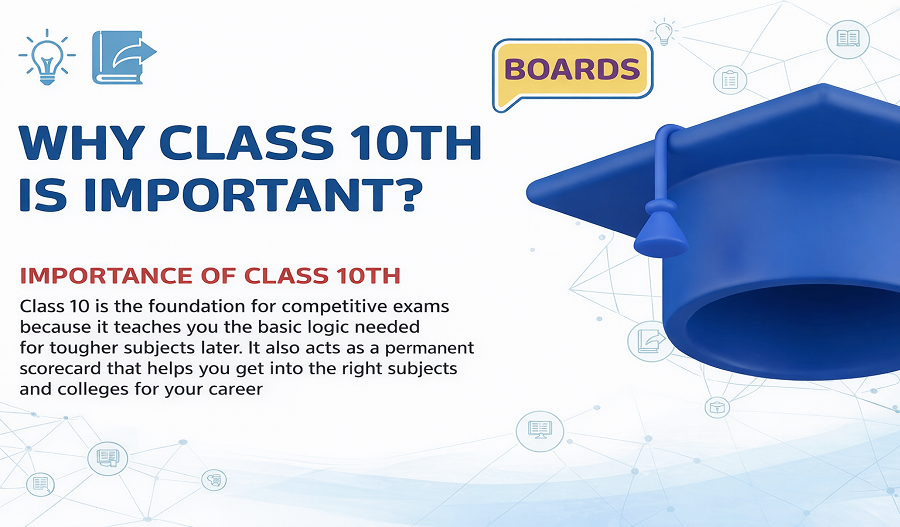
How Class 10 Foundation Impacts All Competitive Exams
The Launchpad for Your Next Decade of Success
Class 10 is not just about board exams. It is not the end of a journey. It is a launchpad.
Think of it this way: if your academic career is a pyramid, Class 10 is the base. The stronger this foundation, the higher you can build. Whether you aim for NEET, JEE, NTSE, Olympiads, or even Civil Services like IAS and IPS years later, everything begins here.
This is the year that shapes the next decade of your learning, your mindset, and your career pathway.
1. Conceptual Clarity: The Bedrock of Advanced Learning
Class 10 Science and Mathematics are not just subjects you study to pass exams. They are building blocks for everything that comes after.
When you learn about force and energy in Class 10 Physics, you are preparing for Mechanics in Class 11, which forms the foundation for JEE Physics. When you study chemical reactions in Chemistry, you are building the groundwork for Physical and Inorganic Chemistry in competitive exams. When you understand human physiology in Biology, you are setting yourself up for success in NEET.
Why Conceptual Clarity Matters
- Students with strong Class 10 concepts face less "learning curve shock" in Class 11
- They do not have to relearn basics - they can focus on building depth
- Conceptual understanding makes problem-solving faster and intuitive
The connection is direct:
- Class 10 Physics (Force, Motion, Energy) → Class 11 Mechanics → JEE Physics
- Class 10 Chemistry (Reactions, Periodicity) → Class 11 Chemistry → JEE/NEET
- Class 10 Biology (Life Processes) → Class 11 Biology → NEET Biology
If your base is weak, you will spend Class 11 trying to catch up. If your base is strong, you can focus on mastering advanced concepts.
2. Logical and Analytical Skills: Moving Beyond Rote Memorization
Class 10 is where you transition from "what it is" to "why it works."
Up until Class 9, many students can get by with memorization. Class 10 is different. It demands understanding. Why does this chemical reaction happen? Why does current flow in this direction? What is the biological reason behind this process?
This shift is critical because almost every competitive exam - from NTSE to UPSC - tests Mental Ability and Logical Reasoning. These skills are developed through foundational studies that make you think, analyze, and connect ideas.
How Class 10 builds this:
- Solving "why" and "how" type questions in Science
- Practicing word problems in Mathematics that require logical thinking
- Understanding cause-and-effect relationships in all subjects
Students who develop analytical skills in Class 10 can solve application-based questions with ease. They do not just know formulas — they know when and how to apply them. This analytical stamina separates top scorers from average scorers.
3. Early Competitive Edge: Mastering the 'Exam Game'
Class 10 is where you can start understanding the mechanics of competitive testing.
Foundation courses and serious Class 10 preparation familiarize you with:
- MCQ-based question formats
- OMR sheet filling (reducing silly errors)
- Time-bound mock tests (building speed and accuracy)
- Strategic guessing and negative marking patterns
Early exposure to these formats significantly reduces exam anxiety. When you sit for your first JEE or NEET mock test in Class 11, it does not feel alien. It feels familiar.
The Familiarity Advantage
Students who have taken timed tests in Class 10 are more comfortable in high-stakes exam environments. Familiarity reduces stress, which improves performance.
4. Effective Time Management: Balancing Boards and Ambition
Class 10 is where you learn a life skill: how to balance multiple priorities.
You have board exams. You might have foundation courses. You have school projects and assignments. Managing all of this teaches you something invaluable - discipline and planning.
Students who develop a "discipline system" in Class 10 learn to:
- Plan months in advance (not just study the night before)
- Track syllabus completion systematically
- Maintain consistency even when motivation fluctuates
- Prioritize high-impact topics over low-impact ones
This is not just about studying harder. It is about studying smarter. Students who master time management in Class 10 handle the massive syllabus of Class 11 and 12 with far less panic. They know how to break down large goals into daily tasks.
5. Reduced Stress: The Gift of a Strong Start
Here is a truth: most students who struggle in Class 11 and 12 are struggling because they are starting from scratch.
They did not build a foundation in Class 10. When they reach Class 11, the volume is overwhelming. New concepts, new difficulty levels, new competition - all at once.
Students with strong Class 10 fundamentals have a different experience. When they enter Class 11, they are already confident in 40% of the core basics. They recognize concepts. They understand the language of the subject. They can focus on depth instead of breadth.
The Stress-Buffer Effect
- Strong fundamentals act as a "stress-buffer" in higher classes
- You handle massive syllabus loads without burning out
- You avoid the panic that comes from not understanding basics
- You sustain effort over 2-3 years without breaking down
Starting from scratch is a major cause of academic pressure. A strong Class 10 foundation avoids this entirely.
6. Mental Maturity: Building Resilience for High Stakes
Success in competitive exams is not just about intelligence. It is about mental strength.
Class 10 is where you start developing this strength. It is the first time most students experience real academic pressure, peer comparison, and social expectations around performance.
This experience, when handled well, builds something invaluable: self-belief and emotional resilience.
Students who achieve structured success in Class 10 develop:
- Confidence to handle pressure situations
- Ability to bounce back from setbacks
- Resilience to keep working when results are not immediate
- Mental toughness to handle competition without crumbling
These qualities compound over time. A student who learns resilience in Class 10 carries it through Class 11, Class 12, competitive exams, college, and professional life. This is not just about clearing exams — it is about building the psychological foundation for long-term success.
Class 10: The First Major Academic Filter
Class 10 is not just another year. It is the first major academic filter that determines career pathways and eligibility for future opportunities.
Your Class 10 marks, your board exam performance, your conceptual clarity - all of these become part of your academic profile. They open or close doors for scholarships, foundation courses, and even college admissions years later.
More importantly, Class 10 determines how prepared you are for what comes next. It sets the trajectory.
View this year not as an endpoint, but as a structural transition toward long-term excellence.
Take it seriously. Build your foundation strong. Develop good habits. Learn time management. Master concepts, not just formulas. Build resilience.
The effort you put in now will pay dividends for the next decade - and beyond.
Your academic journey is a marathon, not a sprint. Class 10 is where you build the strength to run it successfully.
Make it count. Your future self will thank you.

.png)